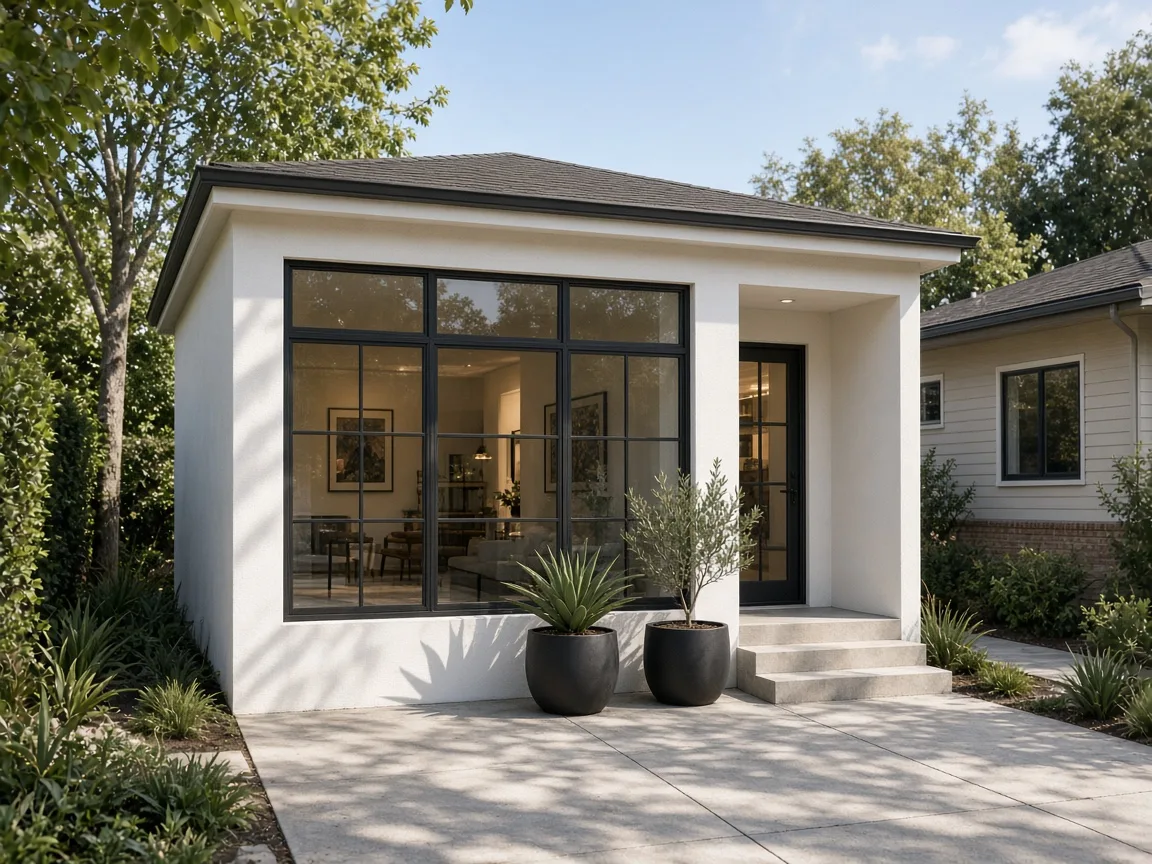
Converting a garage is one of the most popular ways to add an ADU in Southern California. The structure already exists, state law protects the conversion, and the price usually sits well below a new detached unit. "Just a garage conversion" still involves real construction, though. Here's what to expect.
Typical cost
For a standard two-car garage (about 400–450 sq ft), Southern California garage-conversion ADUs commonly run $200–$350 per sq ft all-in. That works out to roughly $90,000–$160,000 for most projects. A larger garage or one needing extensive structural work can cost more. Use our estimator to model your size.
These are planning ranges, not quotes. Get written bids from licensed contractors.
Where the money goes
- Slab and floor: many garage slabs slope toward the door and have no vapor barrier. Your builder may add a sleeper floor, or pour a new slab with an under-slab plumbing trench.
- Plumbing: a new bathroom and kitchen mean cutting the slab for drains and tying into the sewer lateral. This is the most variable cost.
- Electrical: a new subpanel, and often a main-panel upgrade.
- Walls, insulation and windows: framing in the garage door opening, insulating to meet Title 24 energy standards, and adding egress windows.
- Heating and cooling: usually a ductless mini-split.
- Fire separation: if the garage is attached to the house, you'll need rated walls or ceilings between the units.
- Finishes: flooring, cabinets, fixtures and paint.
What state law says about converted garages
California strongly supports garage conversions. Under State ADU Law as summarized in HCD's ADU Handbook:
- No setbacks are required for an ADU built within an existing garage or other legally built structure, or one rebuilt in the same location with the same dimensions.
- No replacement parking. When a garage, carport or covered structure is converted or demolished for an ADU, the city cannot require you to replace those parking spaces. SB 1211, effective 2025, extended this to uncovered spaces (Gov. Code section 66314(d)(11)).
- No size limits apply to conversions of an existing accessory structure, so your existing garage footprint is what you get. Many cities also allow up to 150 sq ft of expansion for ingress and egress.
- Fee relief. Conversions of 750 sq ft or less have no impact fees, and many converted units are exempt from new utility connection fees.
Attached vs detached garages
A detached garage usually becomes a detached ADU with its own entrance. An attached garage can become an attached ADU, or a JADU of up to 500 sq ft if you want a simpler option with lighter rules. See JADU vs ADU.
Common surprises
- Unpermitted garages. If your garage was built or altered without permits, you may need to legalize it first. AB 2533 limits how cities can treat older unpermitted units. See our guide on legalizing an unpermitted ADU.
- Low ceilings. Habitable rooms need minimum ceiling heights, and some older garages fall short.
- Foundation issues. Old slabs on grade may not support new walls without footings.
- Sewer distance. A garage far from the main line or below street level may need a lift pump.
Garage conversion vs new detached ADU
A conversion is usually cheaper and faster to permit. A new detached ADU gives you a better layout, more natural light and usually more square footage. Some owners convert the garage now and build a second detached unit later, where state rules allow.
Hire the right builder
Look for builders who list garage conversions and can show photos of finished conversions, not just additions. Ask whether they have handled slab trenching for new plumbing. On our directory you can filter to garage conversion specialists. Always verify a CSLB license at cslb.ca.gov.
A sample garage conversion timeline
A typical conversion moves through these stages:
- Design and engineering: 4–8 weeks. That covers measured drawings, Title 24 energy calculations and any structural engineering for the slab or the garage-door header.
- Plan check: state law requires cities to approve or deny a complete ADU application within 60 days. Many SoCal cities run faster for conversions, and some offer over-the-counter review.
- Construction: often 10–16 weeks. The usual order is demolition, then slab trenching and underground plumbing, framing and rough-ins, inspections, insulation and drywall, and finally finishes and the final inspection.
Plan for 5–9 months from your first design meeting to a certificate of occupancy.
Questions to ask in bids
- Does the bid include a new slab, or a sleeper floor over the existing slab?
- How far is the sewer connection, and does the bid include a lift pump if one is needed?
- Is a main-panel upgrade included, or listed as an allowance?
- Who prepares the Title 24 energy report and the structural calculations?
- What allowances are included for cabinets, flooring and fixtures?
Comparing these line items is the fastest way to see why one bid comes in $40,000 under another.
Frequently asked questions
How much does it cost to convert a garage into an ADU in Southern California?
Many two-car garage conversions run about $90,000–$160,000 all-in, or roughly $200–$350 per square foot, depending on plumbing, slab and electrical work.
Do I have to replace parking if I convert my garage to an ADU?
No. California law bars cities from requiring replacement parking when a garage, carport or parking space is converted or demolished for an ADU.
Do setbacks apply to a garage conversion?
No. State law does not allow setbacks to be imposed on an ADU converted within an existing legal structure or rebuilt in the same location and dimensions.
Can I turn my attached garage into a JADU?
Yes. An attached garage counts as part of the house, so it can become a JADU of up to 500 square feet, or an attached ADU.
This page is general information, not legal, tax or financial advice. Costs vary by property and builder. Images are AI-generated illustrations. Last updated November 2026.