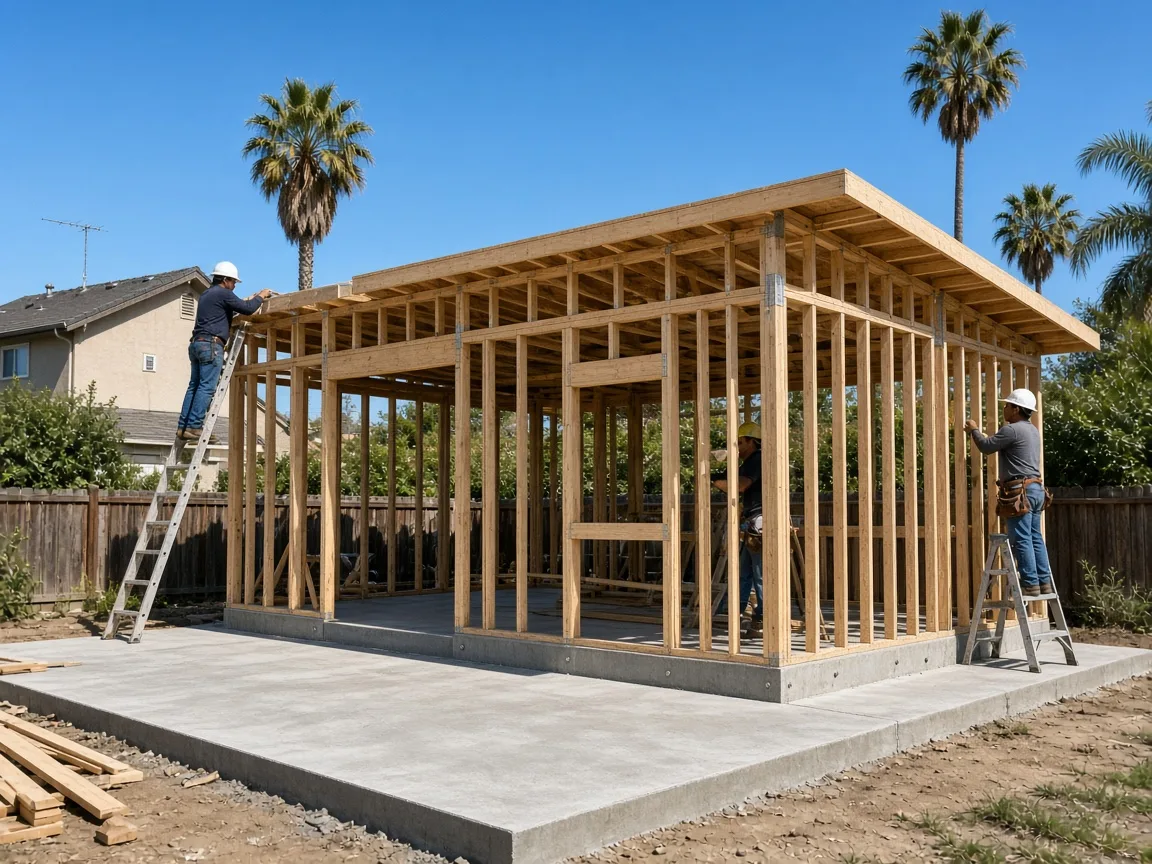
Most Southern California homeowners can expect 9 to 15 months from their first design meeting to move-in for a new detached ADU. A JADU or a straightforward garage conversion can finish faster. A hillside two-story unit can take longer. Here's the realistic timeline, phase by phase.
Phase 1: Feasibility and builder selection (2–6 weeks)
Before design starts, you'll:
- check zoning, overlays and utilities
- talk to two or three builders or design-build firms
- set a budget and a financing plan
Starting here saves the most time later. A builder who spots a sewer problem in week one saves you months. Browse ADU builders by city and our checklist for choosing a builder.
Phase 2: Design and engineering (4–12 weeks)
This covers floor plans, elevations, structural calculations, a Title 24 energy report, and any soils or survey work. Using a pre-approved plan can cut weeks. See pre-approved ADU plans.
Phase 3: Permitting (1–4 months)
State law sets the clocks. A permitting agency must tell you within 15 business days whether your application is complete, as of 2026, and must approve or deny a complete application within 60 days (Gov. Code section 66317). Correction rounds, utility sign-offs and coastal or fire reviews are what stretch this phase. Many Southern California cities now issue ADU permits within a few months. The City of Los Angeles and others offer standard-plan programs that can speed review.
Phase 4: Construction
Typical build times once you have a permit:
- JADU: 1–3 months
- Garage conversion: 2–4 months
- Attached ADU: 4–7 months
- Detached single-story ADU: 4–8 months
- Prefab or modular: 1–3 months on site, but factory lead times can add months before delivery
- Two-story or above-garage: 6–10 months
Phase 5: Final inspection and utilities (2–6 weeks)
The final inspection, the certificate of occupancy, the address assignment, and any separate meter set by the utility. Meter work by SCE, SDG&E, LADWP or local water districts can add weeks, so start those applications early.
The most common delays, and how to avoid them
- Utility surprises. Order a sewer scope and a panel assessment during feasibility.
- Incomplete submittals. Use your city's ADU checklist, and hire a team that has permitted ADUs there before.
- Change orders mid-build. Lock in finishes before construction starts.
- Lead times. Windows, electrical gear and prefab units can take months to arrive, so order early.
- Financing draws. Construction and renovation loans release money in draws. Slow draw inspections slow your builder.
- Weather. Southern California is mild, but winter storms can still delay foundations and roofing.
Does the season matter?
Not much in SoCal, though it helps to permit over the winter and build through the dry months. Builders' calendars matter more. Good builders are often booked out weeks or months ahead.
Can I speed it up?
- Choose a JADU or garage conversion.
- Use a pre-approved plan.
- Stay at 750 sq ft or less to simplify fees.
- Choose a design-build firm that handles design, permits and construction under one contract.
- Respond to plan-check comments within days, not weeks.
A sample timeline: detached 750 sq ft ADU in Riverside County
- Weeks 1–4: feasibility, builder selection, survey
- Weeks 5–12: design, engineering, Title 24
- Weeks 13–24: plan check (two correction rounds), permit issued
- Weeks 25–52: construction and inspections
- Weeks 53–56: final, address, utility meter
That's a little over a year. Shorter is possible. Longer is common when lots have surprises.
Timelines by county
Every jurisdiction runs its own plan check, so timelines vary even within a county. Larger cities such as Los Angeles, San Diego and Long Beach have dedicated ADU programs and standard-plan options. Smaller cities may have fewer staff but also fewer applications. Unincorporated areas follow county rules: LA County Public Works, OC Development Services, San Diego County Planning & Development Services, Riverside and San Bernardino county building departments, and Ventura County. The surest way to forecast your timeline is to ask your builder how long their last three permits took in your exact city.
Living on site during construction
If you live in the main house, a detached ADU build will mean noise, deliveries, and occasional utility shutoffs when new lines tie in. Agree on work hours, staging areas and a portable toilet location with your builder before demolition starts. For garage conversions and JADUs, plan for dust control and temporary storage.
Questions to ask a builder about schedule
- How many ADUs have you permitted in my city in the last year?
- What's your current lead time to start construction?
- Who on your team handles plan-check corrections?
- What does your contract say about delays?
Frequently asked questions
How long does it take to build an ADU in California?
Most detached ADUs take about 9–15 months from design to move-in, including roughly 1–4 months for permitting and 4–8 months of construction. JADUs and garage conversions are usually faster.
How long does ADU permitting take?
State law requires a decision within 60 days of a complete application, and as of 2026 a completeness decision within 15 business days. Correction rounds often extend the overall permit phase to 1–4 months.
Are prefab ADUs faster?
On-site work is faster, but factory lead times, site prep and permitting mean total timelines are often similar. Prefab mainly reduces construction-site time.
What delays ADU projects most?
Utility surprises such as sewer and electrical panel upgrades, incomplete permit submittals, change orders and slow financing draws.
This page is general information, not legal, tax or financial advice. Costs vary by property and builder. Images are AI-generated illustrations. Last updated November 2026.