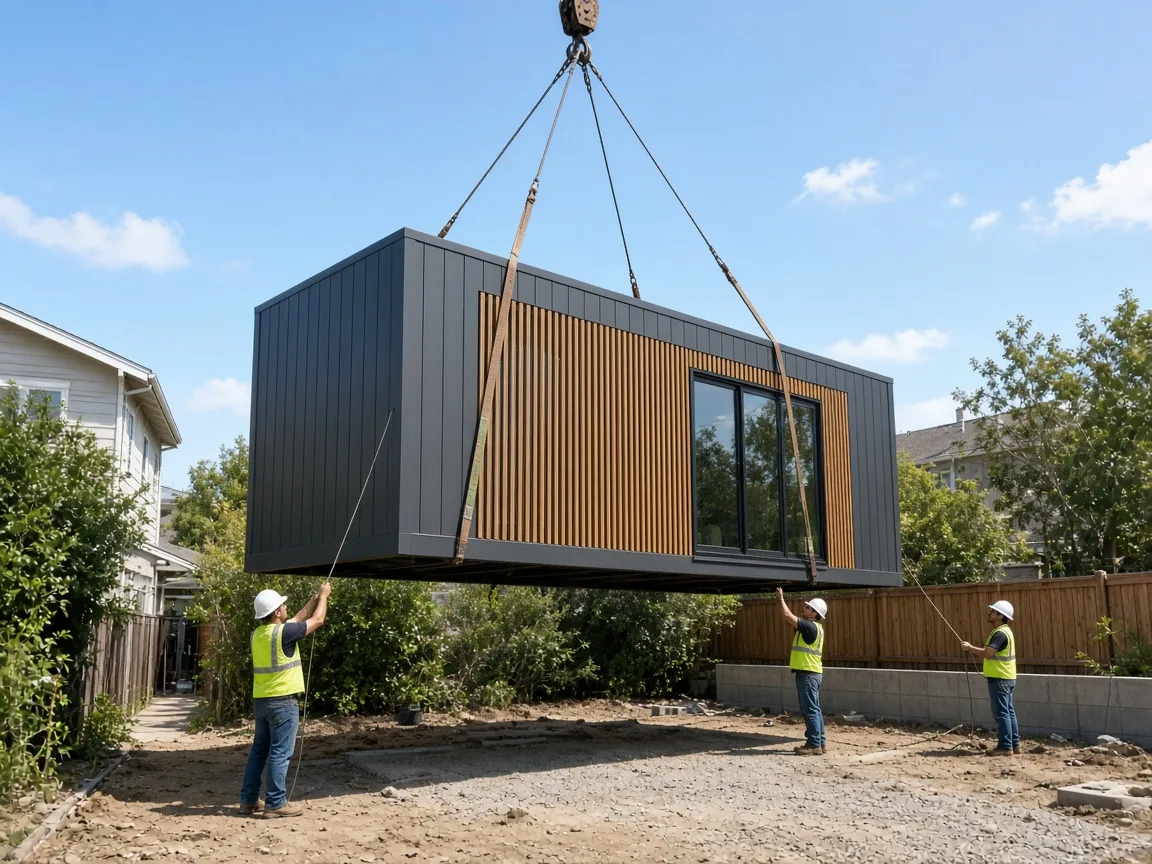
Prefab ADUs promise a faster, more predictable backyard home. Some deliver on that. Others turn into a long wait followed by a site-work bill nobody mentioned. This guide explains the main prefab types, how California permits them, and what "installed" really costs in Southern California.
Four kinds of "prefab"
- Modular: finished three-dimensional boxes, built in a factory and set by crane. California's factory-built housing program (Health and Safety Code section 19960 and following, run by HCD) certifies them to the California building codes.
- Panelized: wall, floor and roof panels made in a factory and assembled on site. Your city's building department typically reviews it much like a site-built home.
- Manufactured (HUD-code): built on a permanent chassis to the federal HUD code. California law treats manufactured homes as an allowable ADU type, and HCD's Handbook confirms that a manufactured home can serve as an ADU.
- Kit or "flat-pack": a materials package with plans. You (or your contractor) still build it.
How permitting works
Every prefab ADU still needs a local permit for zoning, the foundation and the utility connections. The state limits apply exactly as they do for site-built units: 4-foot side and rear setbacks, height allowances of 16 to 25 feet, the 60-day review timeline, and the fee caps for units of 750 sq ft or less. See our California ADU laws page for the details.
Some SoCal cities include prefab designs in their pre-approved plan programs. That can shorten review significantly. See our pre-approved plans page.
What prefab really costs
The headline factory price, for example "$150,000 for a 600 sq ft one-bedroom," usually covers only the unit. Your budget also needs:
- Site prep and foundation: grading, trenching, and a slab or a perimeter foundation.
- Delivery and crane: costs climb fast with narrow streets, overhead power lines, or a backyard far from the curb. Some lots simply can't take a crane, which rules out modular entirely.
- Utility connections: sewer, water, electrical service (often with a panel upgrade at the main house) and possibly gas.
- Permits, plan check, engineering, a soils report and a Title 24 energy report.
- Finish work on site: porches, steps, landscaping and accessibility.
Installed, many Southern California prefab projects land around $325–$550 per sq ft all-in. That overlaps heavily with site-built costs. Try our ADU cost estimator to compare.
Where prefab wins
- Schedule certainty. Factory work runs alongside permitting, and on-site time can drop to weeks instead of months.
- Quality control. Indoor construction avoids weather damage and allows tighter inspections.
- Less disruption. Fewer workers and deliveries over a shorter period.
Where prefab loses
- Access. Tight side yards, hillsides and alley-less lots in LA, Orange and San Diego counties often make crane setting impossible or expensive.
- Customization. Changing a modular floor plan can void its certification or add months.
- Deposits. Many companies require big deposits years before delivery. Read the contract carefully, and know who holds your money and what happens if the company fails.
- Split responsibility. The factory builds the unit, but someone else, often a separate contractor, handles the foundation and utilities. Gaps between the two cause many prefab disputes.
Is it cheaper to build an ADU or buy a prefab?
Usually not by much once you compare installed totals. Prefab's advantages are speed and predictability, not a dramatically lower price. If your lot is easy to access and you like a catalog design, prefab can be excellent. If your lot is tight or you want a custom layout, a site-built or panelized ADU is often the better value.
Questions to ask any prefab company
- What exactly does the quoted price include, and what does it exclude?
- Who is the licensed contractor of record for the foundation and site work? What is their CSLB license number?
- Is the unit HCD factory-built certified, HUD-code, or permitted locally as panelized construction?
- What is the delivery timeline? What happens to my deposit if it slips?
- Can a crane reach my lot? Has anyone done a site visit?
- What warranty covers the unit, and what covers the site work?
Verify licenses
In California, a contractor doing the on-site work needs a CSLB license, typically the B (General Building) classification. In our directory, a "CSLB License Verified" badge means we matched the business to a current CSLB license record. Always confirm a license yourself at cslb.ca.gov. Browse builders that list prefab and modular work.
A sample prefab budget, line by line
Here's how a hypothetical 600 sq ft prefab one-bedroom might break down in Southern California. These are illustrative planning numbers only:
- Factory unit: a large share of the total, but often only about half.
- Foundation and site prep: tens of thousands of dollars, depending on soils and slope.
- Delivery and crane: varies sharply with distance and access.
- Utilities and the panel upgrade: often similar to a site-built ADU.
- Design, engineering, permits and the energy report.
- On-site finish work, decks, steps and landscaping.
The lesson is simple: ask every prefab company for an installed estimate for your specific lot, and get a separate site-work bid from a licensed contractor before you sign.
Frequently asked questions
Are prefab ADUs allowed in California?
Yes. Modular, panelized and manufactured homes can all serve as ADUs, as long as they meet State ADU Law and get a local permit for the foundation and utilities.
How much does a prefab ADU cost installed in Southern California?
Often about $325–$550 per square foot all-in once you add the foundation, delivery, crane, utilities, permits and site work. The factory price alone is much lower.
How long does a prefab ADU take?
On-site work can take weeks, but permitting, factory scheduling and site prep often stretch the whole project to 6–12 months or more.
Do I need a contractor for a prefab ADU?
Usually yes. The foundation, utility connections and finish work are construction work that generally requires a CSLB-licensed contractor.
This page is general information, not legal, tax or financial advice. Costs vary by property and builder. Images are AI-generated illustrations. Last updated November 2026.